NASA, SpaceX Set May 12 Launch for CRS-34 ISS Resupply Mission
NASA and SpaceX are currently targeting Tuesday, May 12, at 7:16 p.m. EDT for the launch of the 34th Commercial Resupply Services mission (CRS-34) with a Dragon spacecraft to the International Space Station. Loaded with about 6,500 pounds of supplies, the spacecraft will launch aboard a Falcon 9 rocket from Space Launch Complex 40 at Cape Canaveral Space Force Station in Florida. After arriving at the orbiting lab, Dragon will autonomously dock to the forward port of the station’s Harmony module at approximately 9:50 a.m. EDT on Thursday, May 14. The spacecraft will remain there until mid-June, when it will undock and splash down off the coast of California in the Pacific Ocean.
The booster supporting this mission will be flying for the sixth time, having previously supported KF-01, IMAP, NROL-77, GPS III-9, and one Starlink mission. This booster will return to land at LZ-40, located just a few thousand feet from where it launched.
This mission will mark the first time a Cargo Dragon will be flown for the sixth time, having previously supported the CRS-22, CRS-24, CRS-27, CRS-30, and CRS-32 resupply missions. While this is a first for Cargo Dragon, Crew Dragon has already surpassed this record; capsule Endeavour completed its sixth flight during NASA’s Crew-11 mission a few months ago.
While the vehicle and payloads are ready for launch, weather is not expected to cooperate for the primary window, with only a 35% chance of acceptable conditions. Threats include lightning and cloud cover rules due to thunderstorms associated with a frontal system. The forecast improves for the backup opportunities, one 24 hours later and one 48 hours later, with the first backup at 65% favorable and the next at 85% favorable.
Many different science experiments are flying aboard CRS-34. Some notable ones include:
ODYSSEY will test how well Earth-based microgravity simulators recreate space conditions experienced aboard the station. Researchers will compare bacterial behavior in space with experiments conducted in microgravity simulators on Earth.
SPARK will determine how red blood cells and the spleen change in space to support future astronaut missions. Scientists will use the data to identify better ways to protect astronaut health during long-duration spaceflight.
Green Bone will observe how bone cells grow and develop in microgravity on a bone scaffold made from rattan wood that simulates real bone. The results could help address conditions such as osteoporosis.
STORIE (Storm Time O+ Ring Current Imaging Evolution) will monitor charged particles in the “ring current” region, where Earth’s magnetosphere holds these particles. The particles respond to space weather events such as solar storms and can affect power grids and satellites in orbit. The experiment aims to improve predictions of these fluctuations.
Laplace will study how dust particles move and interact with each other in space, shedding light on how Earth and other planets formed.
CLARREO Pathfinder (Calibration Absolute Radiance and Refractivity Observatory Pathfinder) will take highly accurate measurements of sunlight reflected by Earth and the Moon which are up to ten times more accurate than those from sensors currently onboard.
Other hardware launching includes a Catalytic Reactor as part of the Water Recovery and Management System, two Universal Pretreat Concentrate Tanks to provide alternate pretreat concentrate for the Universal Waste Management System (UWMS) and Waste Hygiene Compartment (WHC), a new power cable for the European Enhanced Exploration Exercise Device, a new Ultraprobe for the worn ultrasonic inspection tool, and a Remote Sensor Unit to restore spares for the station’s vibration monitoring system.
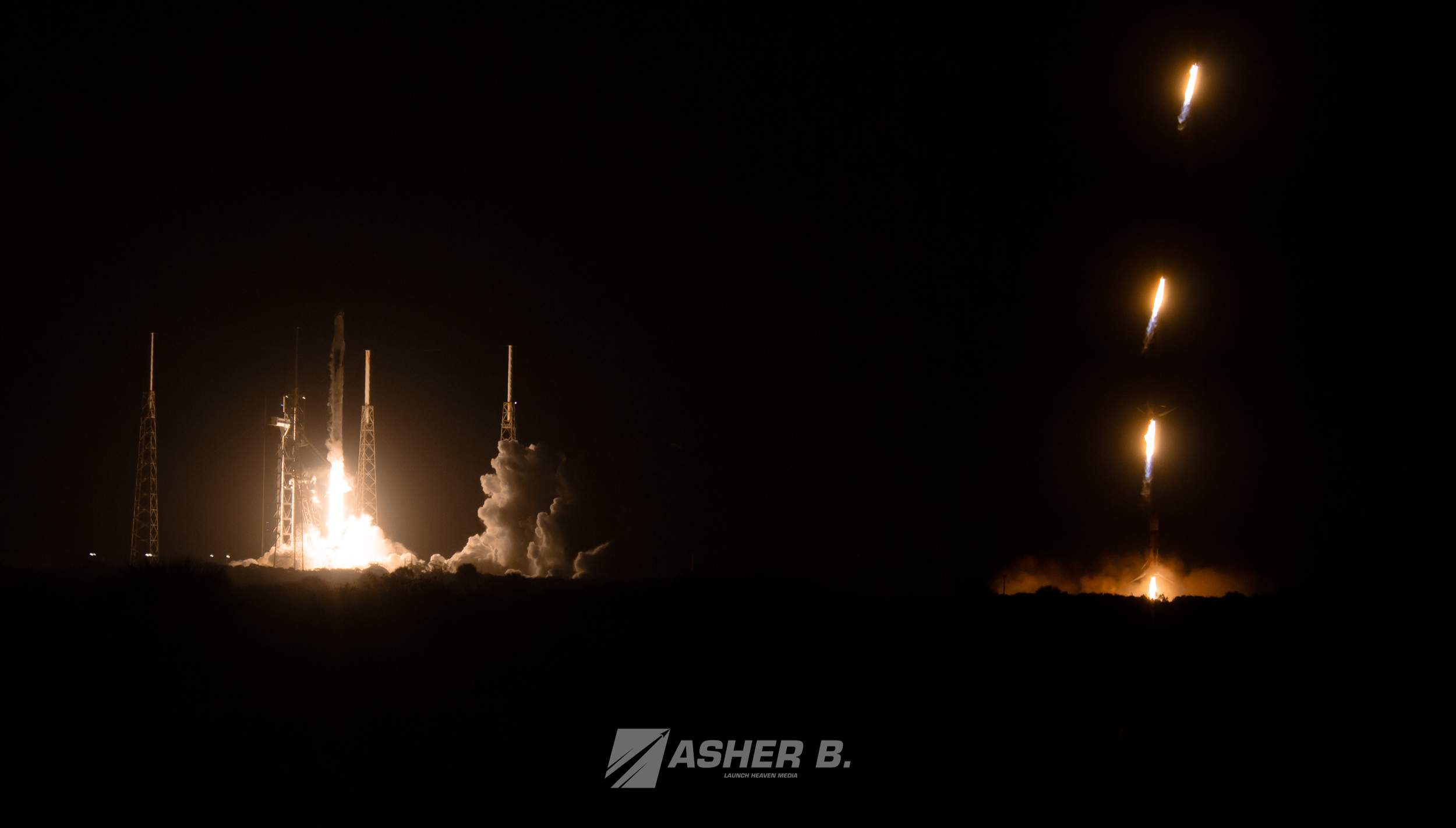
Photo Credit: Asher B. for Launch Heaven Media