Project Starfall and SpaceX’s Plan to Become the Amazon in Space
SpaceX has quietly been cooking up something interesting, and no, it's not another reason to stare at the sky waiting for a rocket booster to land itself. Meet Starfall, an uncrewed reentry vehicle that the company has been developing largely under the radar, until FAA documents blew the lid off the project in May 2026. On May 15th the FAA issued an Final Environmental Assessment and a Record of Decision for two Starfall test flights, greenlighting the first two prototype reentry missions riding atop a Falcon 9, signaling that this thing is closer to reality than anyone expected. Designed to serve as an autonomous commercial platform for microgravity manufacturing, think pharmaceuticals, advanced protein crystals, and semiconductors. On Earth, gravity causes molecules to settle unevenly, disrupting how crystals and biological materials form. In microgravity, those same materials come out more pure, and uniform, which means space-manufactured drugs or semiconductors could genuinely outperform their Earth-bound equivalents. Starfall is also built for point-to-point terrestrial cargo delivery. In other words, SpaceX would like to be your space based Amazon service, with a brief detour through low Earth orbit.
So how does it work, exactly? Glad you asked. Picture disc-shaped reentry capsules, like a hockey puck scaled up to about 3 metres (10 feet) wide, that are loaded with materials and launched into orbit aboard Starship. The capsule carries up to 1,000 kilograms (2,205 lbs) of payload in a compact internal volume, with a total mass at launch of around 3,100 kilograms (6,800 lbs). The disk shape isn't just for aesthetics, the flat, low-profile design maximizes structural efficiency and payload capacity, a deliberate departure from the traditional conical capsule designs to which we've grown accustomed.
The broader ambition here is hard to overstate. SpaceX envisions Starfall as a logistics backbone for delivering products, including pharmaceuticals, exotic alloys, or fiber optics, that are manufactured in microgravity environments and returned to Earth customers. But the project also ties into the U.S. Department of Defense's Rocket Cargo Program, this explores rapid orbital delivery timelines that could drop critical battlefield supplies much faster than traditional methods. Starfall builds on SpaceX's hard-won experience with Dragon capsule and Starship reentry technologies, which means this isn't a moonshot so much as a very deliberate next step. SpaceX has always had a talent for making what sounds impossible actually possible, and with Starfall, they're doing it again.
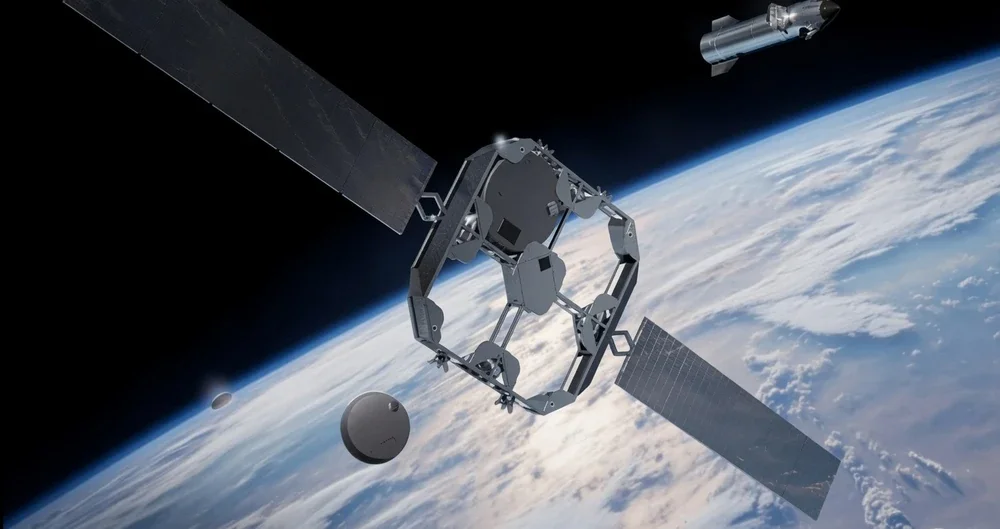
Credit: SpaceX